7B, on an ordinary Tuesday.
From the front of the room, everything looks in order: twenty-four students, each one at their desk.
RADARS is a platform for schools. In a survey, each student shares how things are going with their classmates; the school sees a map of each classroom and knows where to look, so it can be there in time.
From the front of the room, everything looks in order: twenty-four students, each one at their desk.
It happens at recess, on the school bus, in the class chat. In who waits for whom after school, and in who is left without a group when the teacher says “pair up.”
During class, on a phone, each student taps the classmates who are part of their days —for better or worse— and says how things are going with each one. There are no right answers, and no one sees what anyone else said.
Friendships that go both ways, groups that reach across the aisle, a difficult relationship between two desks up front.
She sits by the window. She names three classmates as friends; none of the three names her.
It isn’t a diagnosis or a label. It’s a reason to find Sara and talk with her, before she has to ask for help.
Now Sara has a friend who names her too. Then another. And the school can see that what it did is working.
That is RADARS: the relationships in every classroom, told by its students, so that no one is left out without someone noticing.
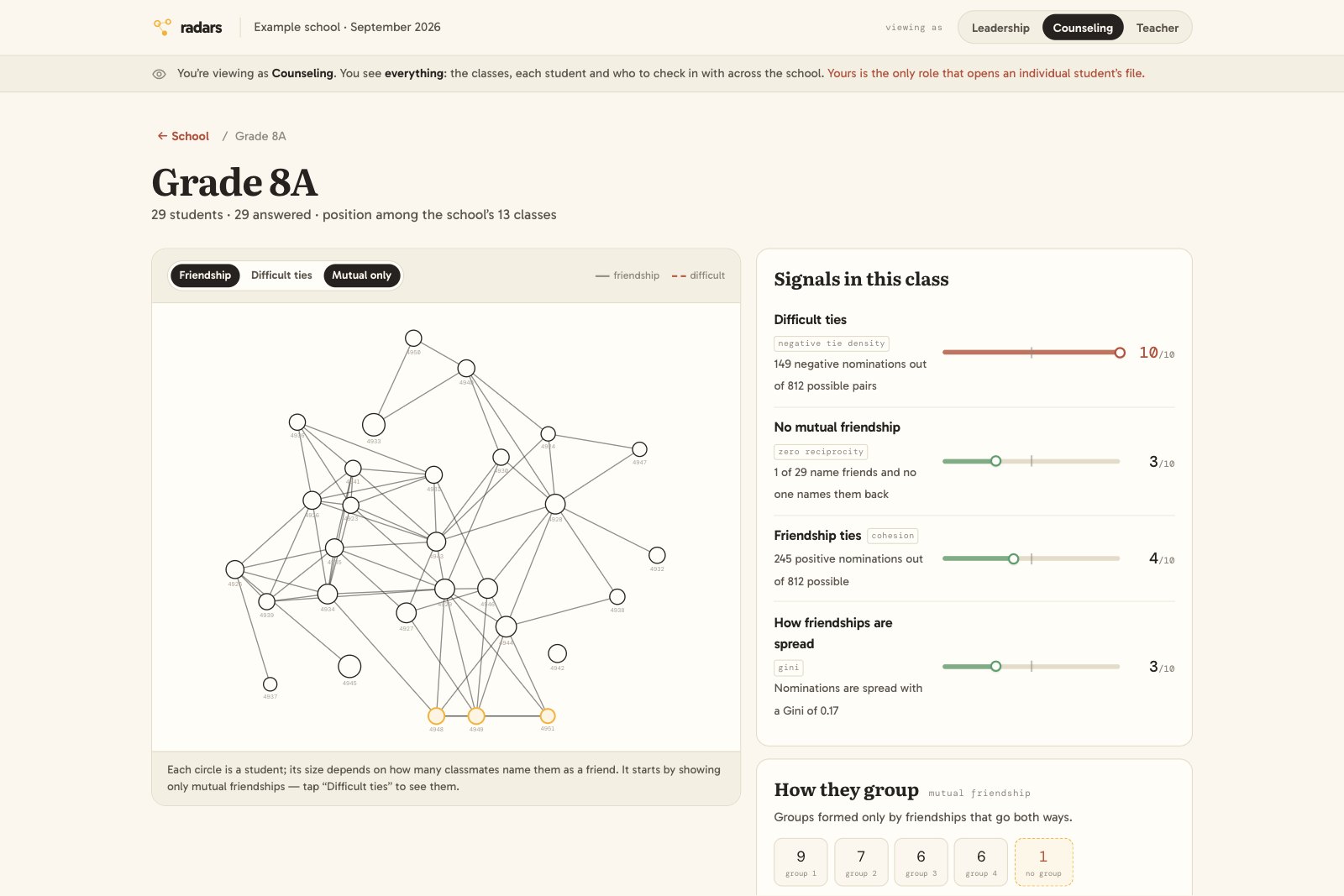
A map of each classroom: who to check in with, and why. Friendships that go both ways show first; difficult ties appear only when someone looks for them.
Sees the whole school, classroom by classroom, and which ones need attention. No individual student files.
Sees everything, including each student’s file, to offer support with context.
Sees their classroom: the map and the groups, to form teams and know who to talk to.
This tool is about children. That is why there are things we decided it will never do.
Each student answers with a code. The list that matches codes to names stays at the school.
It describes what is happening —how many classmates name a student, whether their friendships go both ways— and leaves the reading to people.
It never asks who bullies, and never infers it. It shows who could use support.
Nor does it show who spoke badly of whom.
They answer, and that’s it. No “you have four friends”: what they share is used to look after them, not to compare.
It points to where to look. What to do is decided by the counselor, the teachers and the school’s own protocols.
In a study of 3,827 students at 19 schools, each one was asked whether they were being bullied, and which classmates they thought were. The gap is huge.
In Colombia, Law 1620 requires every school to have a pathway for handling school coexistence (ruta de convivencia escolar). RADARS doesn’t replace it: it gives it information to act sooner.
Some signals will turn out to be nothing. A timely conversation is never wasted.
Brañas-Garza, Cabrales, Kovářík and Vasco (2025), Friends, enemies, and the risk of bullying in schools, working paper, SSRN 4912811. Students aged 11 to 17 in Spain.
This is a demo, with example students and classrooms. If you answer the survey on this same device, you will then appear in the platform as “YOU”.